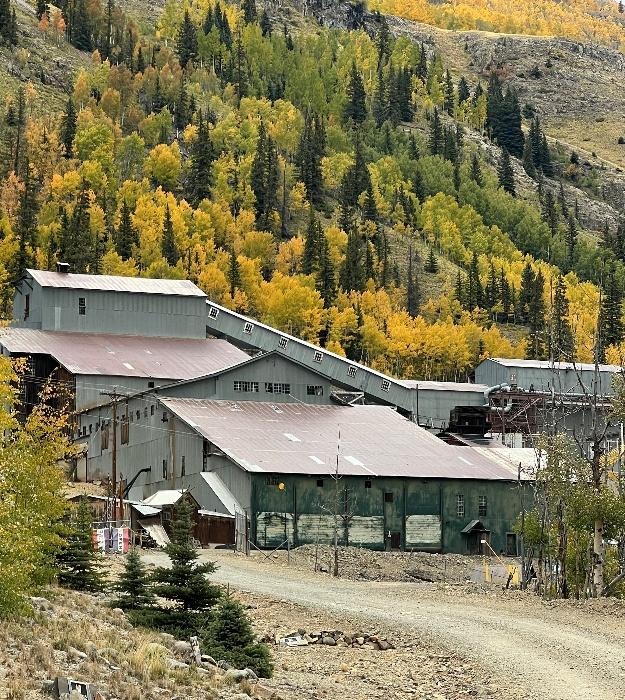
The Shenandoah-Dives (aka Mayflower) Mill
A National Historic Landmark
Built in 1929 by the Shenandoah-Dives Mining Company, the mill has processed ore from numerous mines for four different companies. Known officially as the “Shenandoah-Dives Mill” locals simply called it the “Mayflower Mill” after the mine at the end of the tramway which first sent ore to the mill in 1930. Photo at right is the mill in 1933.
What is “Milling” and “Refining”?
Mayflower Mill & Gold Refinery Tour
San Juan County Historical Society
The rock and ore coming from the mine must be processed to recover the valuable metals. Silverton ores are known as complex-sulfide ores, a mixture of sulfur and other metals such as silver, lead, copper, zinc and iron. Iron pyrite (“fool’s gold”) is the most common ore metal found and is usually mixed in with the other ores. It was not mined commercially unless it contained copper or gold. Gold however, is very different. It is not chemically combined with sulfur, but found in its native metallic state, usually combined with a small percentage of silver.
Milling is the process of crushing then wet grinding the ore as fine as flour making a slurry of metallic ore and worthless rock. This separates the valuable mineral particles from the worthless country rock. Once these mineral particles are “liberated”, two different processes were use to capture the valuable metallic minerals. First, gravity separation was used to recover the heavy gold particles. Gravity processes do not use chemicals, but use machines that work much like automated gold panning, separating heavy gold from lighter material. Second, the minerals that are combined with sulfur (such as silver and lead) are separated and concentrated using the flotation process. This process combined both chemical action and physical action to create bubbles (froth) which the mineral particles stick to and float to the top of special tanks, while the unwanted rock and uneconomic minerals such as iron pyrite stay at the bottom of the tank.
Refining is the process of further purifying something that is already in its metallic state. In Silverton this mean GOLD! The gold particles liberated by the milling process were refined by chemically combining it with mercury making an Amalgam which pulled the gold out of the slurry. The mercury was cooked off in a retort leaving a residue that was about 50% gold. This residue was refined by adding fluxes and melting it at 2,000 degrees F in a crucible so the remaining impurities liquefied into a slag that floated on top of the liquid gold. When cool the brittle slag is hit by a hammer, where it shatters leaving the gold bar now about 85% pure.
Sound complicated? Don’t worry you will see all the processes, machinery and how they work as you tour through the mill/refinery tour using this guide.
MILL HISTORY & PRODUCTION
Built in the summer of 1929, it only took five months to erect this huge timber frame building! Machinery was installed that fall, and the almost two-mile long aerial tramway connected the mill to the Mayflower Mine portal at 11,200 feet elevation in Arrastra Gulch. The mill cost $375,000 to build.
Production began in early 1930 under the direction of Charles A. Chase, General Manager and co-founder of the Shenandoah-Dives Mining Company headquartered in Kansas City, Missouri. Initially the mill could process 300 tons of ore per day but improvements and additional machinery increased this to 700 tons per day by 1937. Metals prices were low during the depression and many mines closed. Chase was a technically skilled mining and process engineer who valued the
men working for him as much as the stockholders. Despite his innovations, the mine and mill never made much money but survived the Depression, World War II, and the Korean War, keeping Silverton’s economy afloat. The mine and mill finally closed in 1953 after processing over 4,000,000 tons of ore and recovering over 400,000 ounce of gold and 8,000,000 ounces of silver!
In 1959 a new company, Standard Metals Corporation, bought the Shenandoah Mill and modified it to process ore from the Sunnyside Mine, the largest mine in San Juan County. The aerial tram was abandoned, and a new crushing house was built at the mill to receive ores trucked from the Sunnyside Mine. Zinc, lead and copper were the primary metals recovered during the 1960’s. But in 1971, high grade gold was unexpectedly discovered in the Sunnyside Mine. Gravity gold recovery equipment was installed and by 1976 the mill was processing over 1,000 tons per day. For a few years it was the largest gold producer in Colorado and the tenth largest in the United States. But like all mines, the good ore finally “played out” and the mill closed for good in 1991.
Slated to be scrapped and the site “reclaimed” under environmental laws, local members of the San Juan County Historical Society proposed the historic mill be saved and converted into a historic site and educational tour. Owner Sunnyside Gold Corporation agreed, and state and federal environmental agencies approved the transfer. The Society acquired the mill in 1996 and opened it to the public for tours in 1997.
During 50 years of operation and production, it is estimated the mill processed about 10,000,000 tons of ore, recovering 1,300,000 million ounce of gold and 30,000,000 ounces of silver, worth over 6 Billion Dollars in today’s prices! Not bad for a mill that cost only $375,000.
Now nearing 100 years old, time and the elements are taking their toll. Grant and volunteer funded efforts are now in progress to repair and preserve the mostly wooden structure. You will probably see evidence of this work as you tour the plant. A new roof is the next priority.
Mayflower Mill and Gold Refinery Tour Route
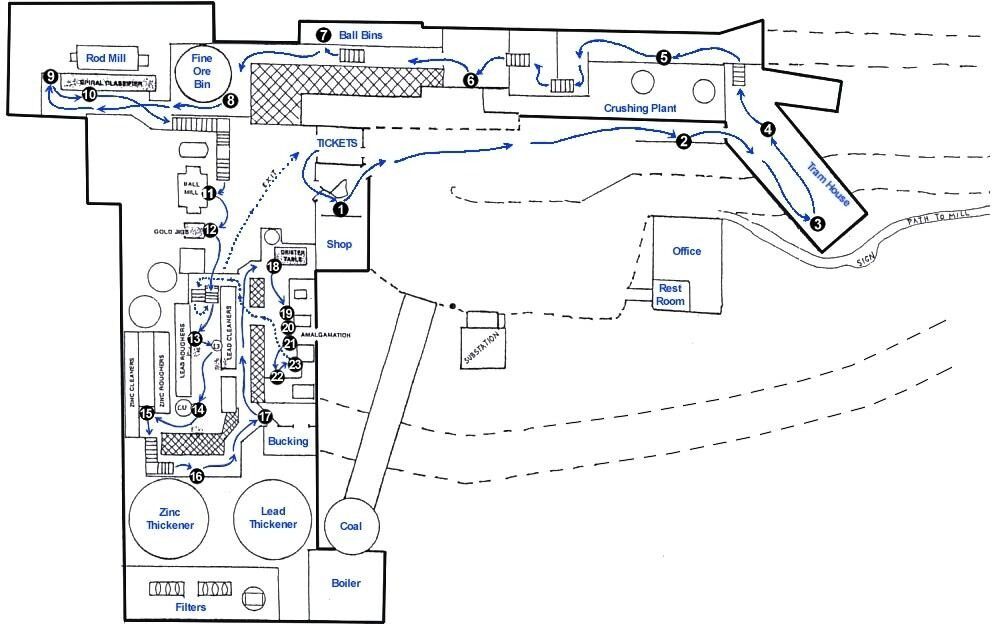
Station 1. Machine Shop
Centrally located, this was also the home of the Maintenance Crew whose responsibility was to keep the mill running and in good repair. They also repaired and sometimes built mining machinery used at the Mayflower Mine.
The major pieces of machinery of the shop are the metal lathe, the shaper, the drill press and the electric arc welder. They were new when installed in 1929 after the construction of the mill. Although over 60 years old, they were still being used daily when the mill was closed in 1991.
The shop could make almost anything needed to keep the mill running. Beside the mill maintenance, the crew built and repaired equipment for the mine as well. Like other small communities, the shop was used on many occasions to keep projects going in town as well, and with the blessings of the Company.
Stations 2 & 3. The Shenandoah-Dives Aerial Tram
Designed by Fred C. Carstarphen and built by Stearn-Rogers Co. of Denver in 1929, the tram’s purpose was to transport ore from the mine to the mill and carry supplies back up.
Employees rode (two per bucket) by placing a small board across the inside of the bucket for a seat and covered themselves during the winter months with a heavy blanket.
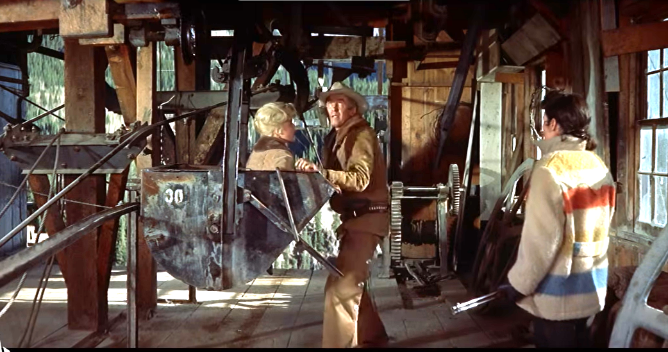
In the fall of 1956 Jimmy Stewart, Audie Murphy, Dan Duryea and Jack Elam used the tram in the climatic ending of the western drama, Night Passage (Universal 1957) Stewart in the tram house below with Elaine Stewart & Diane Foster
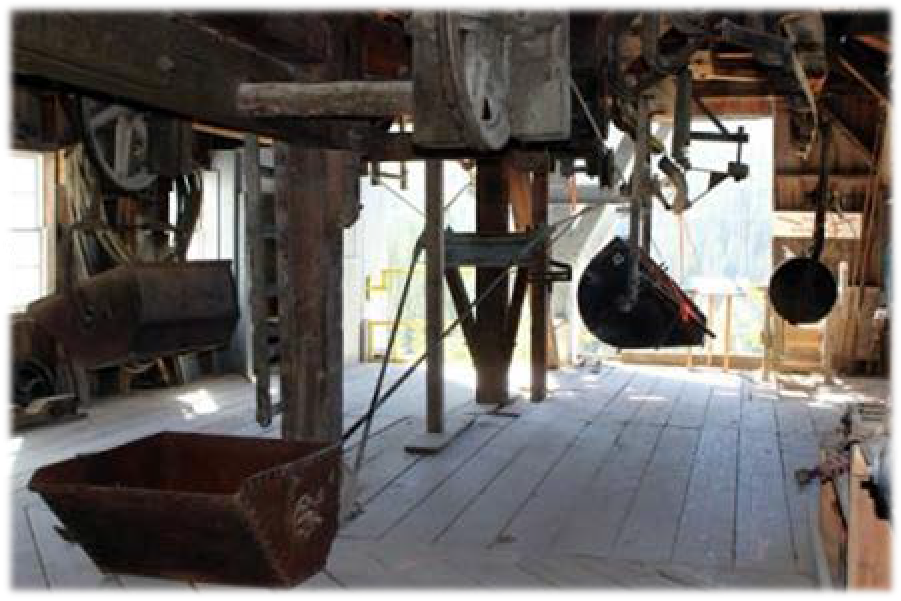
The principle of the tram system is relatively simple. The bucket rides over a large steel cable called the stationary cable. Each bucket was pulled along by another cable called the traction rope. The bucket was attached to the traction rope with a gripper, which automatically gripped itself as it entered or left the tramhouse.
All of the ore coming out of the mine was crushed down to gravel before being loaded onto the tram buckets. As the buckets were loaded with ore and put on the line for their trip down to the mill, the weight of the descending buckets actually powered the tram and generated electricity back into the power grid by using electric braking, much like a hybrid car does today. At full speed the tram made a complete circle (mill to mill) in about 45 minutes. The tram buckets held between 1,600 and 2,000 pounds of ore.
Station 4. Tram Bucket Display
The small bucket is a Huson Bucket by the Hallidie Co. who actually built the San Francisco Cables Cars! This was the first aerial tram system used in the Silverton area. The bucket was attached directly to the traction rope (drive cable) as can be seen in the example of the gripper bolted to the cable lying over the bucket. This is similar to the systems used for chair lifts at ski resorts today.
The larger bucket is a Bleichert Bucket by the Trenton Iron Works in New Jersey. This system started coming into use in the 1890’s and was widespread and very popular. The capacity of the bucket was approx. 350-400 lbs. of ore.
The larger S-D buckets were also used to take mining machinery and supplies to the Mayflower Mine. Heavy machines could be slung between two buckets for the trip up.
Station 5. Crushing Plant
In 1959 Standard Metals Corp. purchased both the Mayflower Mine property and the Sunnyside Mine. While the “new” Sunnyside was being developed for production, limited ore came down over the tram from the leased Silver Lake Unit out the Mayflower Mine portal. Since this ore was already crushed to a gravel size material at the mine it went directly into the mill for processing.
In 1963, with the Sunnyside coming into production and no crushing facilities at that mine, this new crushing plant was built for that purpose. One of the crushers at the Mayflower mine was brought down for the new plant. The ore was shipped from the Sunnyside mine in trucks.
The trucks dumped their ore in a chute behind this building, a conveyer belt carried the ore into the plant and dropped it into the primary jaw crusher which broke it to baseball size material or smaller.
Leaving the jaw crusher, the broken rock was carried up to a screening process for sizing. If it was small enough to pass through the vibrating screen, it was conveyed directly into the mill. If the rock rode over the screen it was carried by conveyer belt to the two secondary crushers for more crushing.
The two Nordberg Symons cone crushers were also called gyratory crushers because of the movement of their interior cone shaped “jaws”. The rock was dropped down the funnel into the top of the crusher. There it passed between the gyrating cone and circular mantel to break the rock down to about ¾ inch. The material carried up to the top of the mill by a conveyor belt and deposited in the fine ore bin, a holding facility.
The crushing plant could break enough rock (1,200 tons) in two 8-hour shifts to keep the mill running for 24 hours. It was a loud and dusty place to work!
Station 6. Conveyer Belt System
A series of belts carried rock from one location to another, either screening or crushing it until it was small enough to enter the mill.
The last belt that carried the final product to the top of the mill is the far one against the wall.
Station 7. Steel Grinding Ball Bins
The steel balls seen here were used in the Ball Mill grinding process of the ore. This was the storage location for the two different sizes used, that were 2″ and 3″ in diameter.
As the balls were needed on a daily basis, they would be dropped into the pipe where they would roll down by gravity and enter the ball mill #11 below.
Station 8. Fine Ore Bin
This was the holding facility for all of the crushed ore coming from the crushing plant. Three steel chutes in the bottom of the tank metered the ore onto another belt to carry it into the rod mill to begin processing. The bin has the holding capacity of 900 tons, enough to run the mill for a day or so.
Station 9. Dominion Rod Mill
Called a Rod Mill because it is loaded with approximately 192 solid 500 pound steel rods weighing 48 tons in total. With the mill rotating clockwise using a 400 HP motor, the rods acted like a giant tumbler grinding the gravel down to about 1/10th of an inch. In order to maintain the initial 48 tons of weight, 2 to 3 rods were charged into the mill daily since the rods slowly wore down to small fragments.
With the Rod Mill running, the ore was continuously fed into the back from a conveyer belt. It was here that water was first introduced to the dry ore entering the mill. This created a slurry consisting of about 50% water and 50% ore by weight. The ore was ground down and discharged at the front of the mill Spiral Classifier (Station 10).
Note: From this location and through the entire mill, all of the ground ore was mixed with large amounts of water that gave it the look of a dark gray dirty liquid. This color was due to the pulverized rock and metallic minerals. Through its entire process the mill used around 1,000 gallons of water per minute. The water for the mill came from Arrastra Gulch, the same gulch that the Mayflower Mine is situated in.
Station 10. Atkins Spiral Classifier
All of the sand/water slurry entering the Classifier was immediately graded by particle size. If the sand was fine enough it would flow with the water up and over the bulkhead (lower end) and would immediately descend through a pipe to the Ball Mill and cyclone separator for further grinding. The coarser sand that was too heavy to flow with the water would drop to the bottom of the liquid and be spiraled up to the top of the Classifier where it reentered the Rod Mill for further grinding.
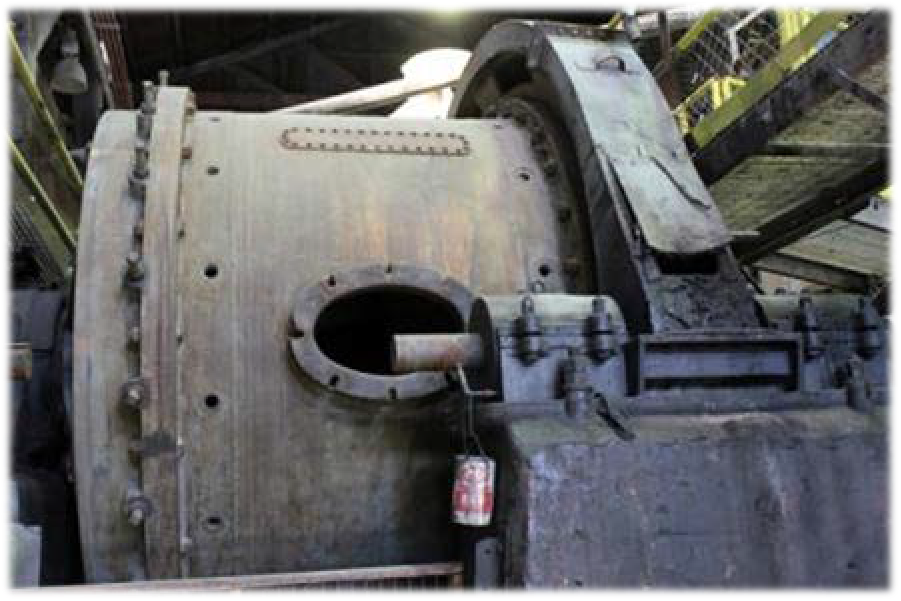
Station 11. Marcy 8×6 Ball Mill
This was the final step of the grinding circuit. The mill was loaded with 25 tons of steel balls (2″ and 3″ in diameter). The rotating effect (like the Rod Mill) would grind the rock down to a fine a flour, about 1/200th of an inch. This fine ore slurry was called Pulp.
These balls would wear down over time and in order to maintain the initial weight, 50 new balls were loaded into the mill daily, rolling down through a pipe from the Ball Bins #7 above. All of the Pulp discharging from the mill would immediately enter the Denver Duplex Gold Jig (Station No.12).
Station 12. Denver Duplex Gold Jig
All material leaving the Ball Mill passes through the Jig. Approx. 70% to 80% of the gold along with portions of other metals (mostly lead) were recovered here.
The jig is a mechanical separator. The pulp would pass through a screen and pulsating rubber diaphragms would cause the heavy gold and lead mineral galena to settle to the bottom of the tapered tank.
Periodically the tank would be drained into a holding tank and the “Jig Concentrate” would be fed onto the Deister Table to start the gold refining process. This will be seen further into the tour Station #18.
Station 13. Lead Flotation Cells
The bulk of the lead, silver, copper and some fine gold that escaped the Jig was floated in these cells. The main bank of cells floated off the lead and copper. The cells on the far west side float off the zinc.
A pungent chemical called xanthate caused the minerals to stick to the bubbles generated in the floatation cells, which looked much like a series of milkshake mixers!
Selective Flotation
The flotation process can separate sulfide minerals from other metals and waste material by floating them to the surface of the slurry with the use of Reagents called Collectors. Different reagents were used for different metals. The floated mineral is skimmed from the surface of the slurry into its own concentrate. The remaining metals are kept to the bottom of the cell with reagents called Depressors, move on to other cells for their own later separation. After all valuable minerals are removed by flotation, the remaining ground up rock and worthless minerals such as iron pyrite are called mill Tailings. The tailings are settled in large ponds and the clear water discharged into the river. There are four prominent tailings ponds below the mill towards Silverton.
The Flotation Cell
When in use, the cell is full of pulverized rock in solution, called Pulp. This solution enters the cell at the bottom on one side, passing through and exiting on the other side into the next cell in the line. The solution is in constant motion entering one end of a cell bank and leaving from the other end.
In the center of each is an impeller that rotates, agitating the solution. At the same time compressed air was introduced down through the shaft of the impeller, spreading out at the bottom of the cell making bubbles. Reagents called Collectors caused the liberated mineral to attach to the bubbles. They rose to the surface in the form of froth, bringing the mineral with it, there to be skimmed off as a concentrate.
Reagent Feeder
This is a typical reagent feeder used throughout the mill. All chemical reagents were made up into 10% solutions and metered with these feeders. Lime was the only reagent not used in solution form and was dry fed.
As the reagent was supplied through a pipe coming from larger tanks above, the bowl had a float, which would keep the solution at a
constant level. As the “water wheel” turned,
it picked up the reagent and delivered it into the flotation cell. These feeders could be set to give a steady trickle to a slow drip.
Station 14. Copper Flotation Cell
Here the copper was separated from the lead concentrate. With the copper being a small percentage of the two metals, only one cell was required for separation. This is a Column Cell using a compressed air bubbler rather than propellers to make the froth.
The copper mineral in the froth flowed up over the top of the pipe into the catch box. This concentrate was piped down to the Copper Filters for final treatment, while the Lead Mineral concentrate went to the Lead Thickener Tank to start the de-watering process.
Station 15. Zinc Flotation Cells
Zinc was now the only commercial material metal left to recover from the pulp, and was floated here. All of the remaining material was sent over to the Scavenger Cells for a final cleanup of any remaining minerals.
Station 16. Thickener Tanks
Directly below is the Zinc Thickener Tank and to the left the Lead Thickener. Now empty, the two tanks when being used would have been full or water. The purpose of the tanks was to settle the concentrates and eliminate the majority of the water
The principle of the Thickener for de-watering was simple. With the tank already full of water and as more concentrates in solution were deposited into the tank, the heavy mineral would immediately drop to the bottom. With no place for the water to go, it overflowed the edge of the tank into the Launder which surrounds the perimeter. This water solution was discarded as a waste and pumped out to the Tailings Pond for disposal. About 90% of the water was eliminated in this manner.
With the rakes slowly rotating to keep the concentrate from caking to the bottom of the tank, the thickened mineral solution was forced to the center of the tank by the rake.
Here it dropped through the funnel-shaped outlet in the bottom to be pumped with a limited amount of water to the filters for final separation of mineral concentrate and water. Each concentrate was piped to its own vacuum filter bank on the next level (not visible) to remove the remaining water. The concentrates contained about 10% water by weight after filtration. Then the “dry” concentrate was dropped into a bin for later loading onto trucks for shipment to the railroad in Montrose then on to the Smelters.
Prior to 1953, the concentrates were trucked down to the narrow-gauge train in Silverton and loaded onto cars to ship to the smelter in Leadville. The steady shipments of these concentrates kept the narrow-gauge Silverton Branch running through the Depression when many other narrow-gauge lines in Colorado were abandoned. This kept the Silverton Train running long enough to be discovered by Hollywood, and then the general public, creating the now famous Durango & Silverton Narrow Gauge Railroad, a world-class scenic attraction.
Station 17. Sample Preparation
This was the location where the daily mill and mine samples were prepared for Assaying (the process of measuring the amount of metal in a given sample).
All samples going to the Assay Lab had to be dry and sometimes pulverized. With most of the mill samples wet or in slurry form, water was eliminated in in these filter presses. Compressed air pushed out the water through the filter cloth. The samples were then placed in trays and dried in the ovens in the adjacent room. Then in envelopes and sent to the Lab for assaying.
Mine ore samples were also dried, crushed and pulverized into powder and sent to the assay lab. The results of these assays gave the company the information needed to determine the grade of ore coming from the mine and daily milling results.
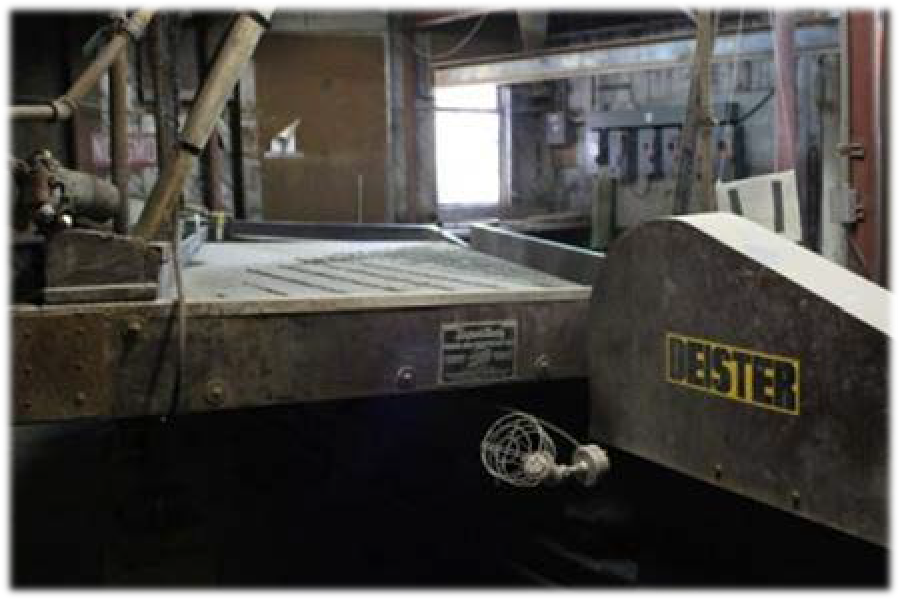
Station 18. Deister Table
As previously mentioned, the Jig Concentrate was deposited in a holding tank sitting above this room. The funnel-shaped container in the cutout on the far wall is the bottom of that tank.
The jig con was mixed with water and piped to the Deister Table. With the table shaking and water washing down over the
table, the Jig “con” spread out over the surface. As the material began working its way over the riffles and towards the right-hand end, the water washed the lighter particles over the bottom edge to be shipped back into the milling process.
The Gold and Lead stayed high on the table and separated themselves into two distinct bands of concentrate. Most of the lead was also saved with the gold since the two metals are very close to the same weight and become mixed as they came together. These two metals would fall off of the end of the table into a trough to be deposited into the steel Jig Con boxes you see here on the floor. With the contents assayed and then weighed (usually about 1-ton) a box was picked up with the Chain Hoist you see here and transported over the monorail into the next room to start the Amalgamation process.
Station 19. Amalgamation
With a Jig Con Box placed onto the framework above the Amalgamation Barrel, all the material was washed into the barrel with a water hose. The barrel is like a miniature ball mill and contained 1250 lbs. of steel balls. The barrel was then filled with water, the door closed, and rotated for 3 hours on high speed. At the end of this period, approx. 80 lbs. of Mercury was added, the amount determined by the ounces of gold involved. This final mixture was again rotated for 3 hours but on a lower speed.
During the amalgamation process the contents were ground to a fine consistency. The gold particles chemically combined with the mercury making a soft substance called Amalgam. Silver amalgam was used for many years to fill cavities. Gold amalgam is very similar. Since the mercury would not pick up any other metal or waste, the remaining lead material was sent to the Lead Thickener and thence to the smelter.
Station 20. Elutriation
At the end of the seven-hour rotation period the barrel was stopped. The liquid pulp and excess liquid mercury were slowly emptied through a small porthole in the barrel into a piece of machinery on the floor below called an Elutriator. This was a process similar to a cream separator in the sense that all of the liquid swirled around the inside throwing the water and any light material to the side,
allowing heavy Mercury and Gold Amalgam to drop straight through into a bucket at the bottom.
Station 21. Amalgam Press
With a fitter placed on the perforated bottom door and closed, the thick Mercury-Gold mixture from the Elutriator was poured into the top of the press. With the top door closed, compressed air was supplied to the press,
which forced the excess Mercury to pass through the filter and drop into a bucket of water. This procedure took from 20 to 30 minutes. At this point the air was turned off and bled and the press opened up.
The product was a semi-hard cake the circumference of the press and several inches thick depending on how much gold was present. The color was pewter gray since the gold particles were still combined with mercury. This substance was called Amalgam. The word actually means, “Mercury mixed with metal”. You can also make a Silver Amalgam or Copper Amalgam since Mercury will pick up these metals as well.
Station 22. Retort
The now hard Amalgam was taken from the press to the table and broken down into small pieces. These pieces were placed in the steel half-moon shaped vessels called Boats. The Boats were ¾ full when they were placed in the Retort Oven. With the door
closed and sealed with a Fire Clay compound
(to make it airtight) the heat was turned on.
The principle of the oven was to vaporize the Mercury from the Gold, called “Retorting”. As the temperature rose the Mercury would change to a vapor form. This vapor (extremely poisonous) would go through a water-cooled condenser that turned the vapor back into a liquid that would drop into a bucket of water at the bottom of the retort oven. After approx. 12 hours with the temperature held at 1,200 degrees Fahrenheit, the mercury would be completely driven off. The Retort would then be turned off and allowed to cool, requiring another 12 hours.
With the oven opened the Boats would be taken back over the table and with a sharp blow from a hammer the gold residue would fall out. This chunk of metal was full of air pockets so was called a Gold Sponge. It was only about 50% gold plus some silver and copper. For many years this was as far as the Company processed their Gold. The Sponge was then sold to The Englehard Refinery in Los Angeles where it was refined into gold bullion that was 95% to 99.9% pure. An interesting comparison: Jewelry Gold is measured in Carats. Twenty-four (24) carat gold is pure gold. The average piece of jewelry is 14 carats which is 58% gold.
On the table with the Boats is a replica Gold Sponge as it would look coming from the retort. The average size would weigh 22 pounds. If containing 50% gold it would contain 264 ounces. If sold at $300 per Troy oz., the sponge would be worth $79,000. Today with gold at $4,700 dollars per ounce it would be worth 1.2 million dollars! Four to five sponges were produced a week.
Station 23. Bullion Refining Furnace
This Propane fired furnace was installed the last year the mill operated (1991). The purpose was to eliminate the use of mercury and the entire Amalgamation Process.
This furnace took concentrated gold from the Deister Table and a second table called a Gemini Table. The Gemini is the small diamond shape shaker table in the Refinery Room. The Gemini could remove enough impurities that the remaining gold could be directly melted into a bar in the Refining Furnace.
The gold concentrate was mixed with silica sand and borax flux. As it melted the impurities would go into a silica slag. After cooking the molten slag and gold would be poured in the cast iron molds. The slag would solidify into glass and could be knocked off the bar with a hammer. The resulting bar called Dore was 80 to 85% gold, 10 to 15% silver and about 5% copper.
It could be sold for a higher price than the old Amalgam Sponge.